PanAfriWoke Intelligence Report

Who wrote the rules that still shape African power?

The African Power Files

Treaties, Contracts, Borders, and the Fight for Sovereignty

Africa's political independence did not begin with a blank sheet of paper. New governments inherited boundaries, financial arrangements, commercial contracts, infrastructure systems, tax relationships, property records, archives and international agreements.

The African Power Files examines those documentary foundations and asks what they still mean today — from monetary arrangements and debt contracts to resource concessions, borders, investment rules, cultural ownership and the archives that preserve evidence of the past.

The report begins with a simple principle: find the document, understand the mechanism, measure the consequence, identify the legal position today, and then decide what should change.
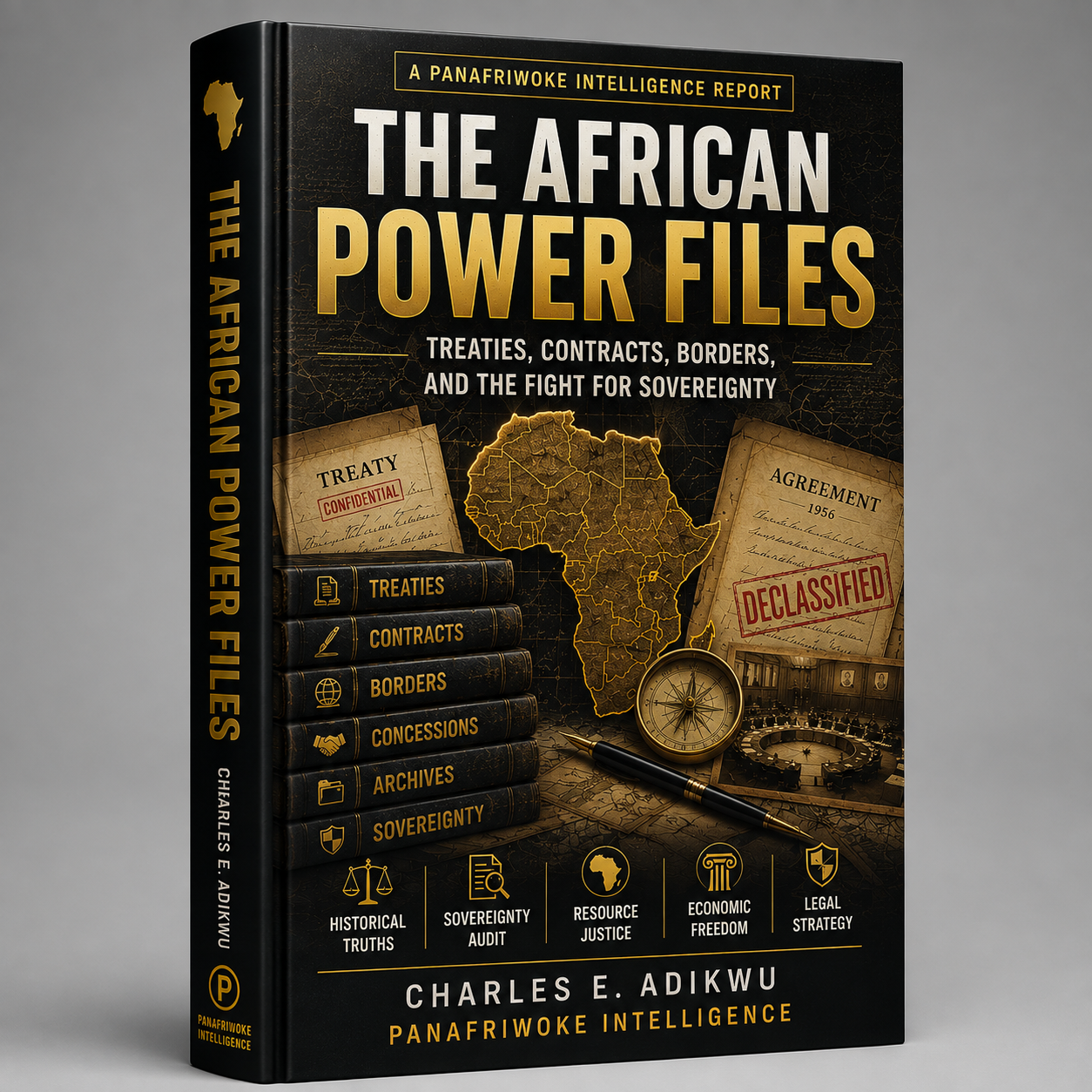
A PanAfriWoke Intelligence geopolitical and historical research report by Charles E. Adikwu.

International buyers: your checkout will show the applicable payment and currency options through Selar where available.

The African Power Files, a PanAfriWoke Intelligence report by Charles E. Adikwu, shown as a hardcover edition

The Question

Africa won political independence.The harder question is:How much of the architecture of power was actually rewritten?

Political independence did not erase every treaty, contract, border, concession, tax relationship, archive or institutional arrangement inherited from earlier periods.

  • Some were replaced.
  • Some were renegotiated.
  • Some became African institutions.
  • Others continued to influence policy long after independence.

The report investigates these mechanisms through documents, legal frameworks, historical records and strategic analysis.

Editorial diagram — the documentary chain

  1. Document
  2. Right
  3. Institution
  4. Economic effect
  5. Legal position
  6. Negotiating power
  7. Sovereignty

What the report examines

The documents behind the power

The report does not treat African sovereignty as an abstract political slogan. It follows the documentary architecture through which power can be created, transferred, preserved, challenged and renegotiated.

01

The Financial Architecture

What do monetary arrangements, debt contracts and tax rules reveal about the price of independence?

  • Monetary treaties
  • Reserve arrangements
  • Debt contracts
  • Immunity clauses
  • Sankara and financial independence
  • Colonial tax treaties
  • Profit shifting and illicit financial flows

02

The Concession Files

Who holds rights over land, minerals, oil, forests and strategic infrastructure?

  • Mining concessions
  • Colonial land agreements
  • Oil contracts
  • Environmental liability
  • Timber concessions
  • Port concessions
  • Long-term monopoly rights

03

The Leaders' Files

What economic visions did African leaders and institutions attempt to build — and what happened to them?

  • Lagos Plan of Action
  • Kwame Nkrumah
  • Volta River Project
  • ECOWAS monetary vision
  • OAU economic vision
  • AfCFTA historical development
  • Patrice Lumumba and mineral sovereignty

04

The Border Files

How do borders, maritime rights, arbitration and infrastructure shape sovereignty?

  • 1964 OAU border principle
  • Maritime boundaries
  • EEZs
  • Investment arbitration
  • Colonial railway geography
  • Diplomatic privilege
  • Customs enforcement

05

The Cultural Files

Who owns the records, objects, knowledge and cultural systems through which African history is preserved?

  • Museum restitution
  • African artefacts
  • Traditional music
  • Folklore
  • Traditional knowledge
  • Botanical knowledge
  • Royal archives
  • Language and commercial law

06

The Sovereignty Audit

How can historical records become practical institutional power?

  • Treaty and contract audits
  • Sovereignty Audit Matrix
  • Historical power map
  • Legal and economic strategy
  • Institutional coordination
  • The African Sovereignty Framework

Signature framework

The Sovereignty Audit

A conceptual audit framework from the manuscript. It is a sequence of investigative steps, not a numerical score.

  1. 01Locate
  2. 02Authenticate
  3. 03Classify
  4. 04Map rights
  5. 05Compare with current law
  6. 06Measure economic effect
  7. 07Identify remedy
  8. 08Negotiate / Litigate / Reform

Conceptual framework — The African Power Files

Evidence

The file is only as strong as the evidence.

The report separates documentary fact from illustration, unresolved questions and strategic interpretation.

01

Verified data

A factual statement supported by a primary document, official institution, court record or high-quality research.

02

Illustrative example

A specific case used to explain a wider mechanism. It does not automatically prove a continent-wide pattern.

03

Investigative claim / question

A claim or unresolved historical question that requires examination of the original record before it can be treated as established fact.

04

Strategic analysis

Interpretation of the evidence and discussion of what African governments, institutions, businesses and researchers could do with it.

The progression

From archive to sovereignty

The report's central strategic argument is not that historical records matter only as history.

Records become strategically important when institutions can locate them, authenticate them, establish rights, measure consequences, connect evidence across institutions, negotiate from it, enforce decisions and convert recovered knowledge into productive capacity.

This is a conceptual framework, not a statistical model.

  1. Know01
  2. Own02
  3. Audit03
  4. Connect04
  5. Negotiate05
  6. Enforce06
  7. Create07
  8. Scale08

What you'll learn

After reading the report, you will understand:

  1. 01

    Why treaties, contracts and financial arrangements can remain relevant long after the political circumstances in which they were created have changed.

  2. 02

    How concessions involving land, minerals, petroleum, forests and ports can be examined through the documentary record and current legal frameworks.

  3. 03

    Why African economic history includes major regional and national projects that attempted to build greater industrial and financial independence.

  4. 04

    Why borders, maritime rights, investment arbitration and infrastructure geography are also questions of sovereignty.

  5. 05

    How cultural objects, traditional knowledge, archives and language can become matters of legal and institutional power.

  6. 06

    How a structured sovereignty audit can move from historical evidence toward modern negotiation, reform and institutional strategy.

Inside the report

6 chapters. One documentary question.

What do the records reveal about the architecture of African power?

  1. Chapter 1

    The Financial Architecture

    Treaties. Debt. Tax. Monetary arrangements. Financial independence. Illicit financial flows.

  2. Chapter 2

    The Concession Files

    Land. Minerals. Oil. Forests. Ports. Long-term rights.

  3. Chapter 3

    The Leaders' Files

    Lagos Plan. Nkrumah. Volta River Project. ECOWAS monetary vision. OAU economic vision. Lumumba.

  4. Chapter 4

    The Border Files

    1964 OAU border principle. Maritime rights. EEZs. Investment arbitration. Railway geography. Customs and sovereignty.

  5. Chapter 5

    The Cultural Files

    Restitution. Traditional knowledge. Intellectual property. Archives. Language. Commercial memory.

  6. Chapter 6

    The Sovereignty Audit

    Treaty and contract audit. Sovereignty Audit Matrix. African Historical Power Map. Archive-to-action strategy. African Sovereignty Framework.

The core idea

The document is not the end of the story.

  • A treaty connects to a central bank.
  • A concession connects to taxation.
  • A tax treaty connects to corporate structure.
  • A mining contract connects to a port.
  • A port connects to a railway.
  • A railway connects to a border.
  • A border connects to a court.
  • A court record connects to an archive.
  • An archive connects to a cultural claim.

Power lives in those connections.

Conceptual map — not a statistical relationship

  1. Treaties01
  2. Finance02
  3. Concessions03
  4. Infrastructure04
  5. Borders05
  6. Courts06
  7. Archives07
  8. Cultural claims08
  9. Sovereignty09
The African Power Files, a PanAfriWoke Intelligence report by Charles E. Adikwu, shown as a hardcover edition

The report

The African Power Files

Treaties, Contracts, Borders, and the Fight for Sovereignty

By Charles E. Adikwu · PanAfriWoke Intelligence

What you receive

  • Full digital intelligence report
  • Research-driven geopolitical and historical analysis
  • Evidence-conscious documentary investigation
  • Financial and monetary treaty analysis
  • Resource and concession analysis
  • Pan-African economic history
  • Border, arbitration and sovereignty analysis
  • Cultural restitution and intellectual-property analysis
  • Sovereignty Audit Matrix
  • African Historical Power Map
  • African Sovereignty Framework
Format
PDF
Delivery
Digital
Price
₦10,000
Get the report

International buyers: your checkout will show the applicable payment and currency options through Selar where available.

Why this report is different

Read the record. Follow the mechanism.

The report is structured as an intelligence investigation rather than a conventional history book. It does not treat the past as a closed chapter.

It follows documents, treaties, contracts, concessions, borders, legal frameworks, institutional records and cultural archives toward the questions they raise in the present.

Verified data

Claims supported by credible documentary or institutional evidence.

Illustrative example

Concrete cases used to clarify wider mechanisms without treating one example as universal proof.

Investigative claim / question

Issues that require further scrutiny rather than being presented as settled fact.

Strategic analysis

Interpretation of what the evidence means for African legal, economic, institutional and sovereignty strategy.

Readership

Who is this report for?

  • 01Readers interested in African political economy and sovereignty
  • 02Researchers and students of African history
  • 03Policy observers
  • 04Lawyers and legal researchers interested in treaties, contracts and sovereignty
  • 05Journalists and investigative researchers
  • 06Pan-African thinkers
  • 07Entrepreneurs and institutional leaders interested in the history behind economic structures
  • 08Readers interested in African resource governance
  • 09Readers interested in restitution, archives and cultural ownership
  • 10Anyone trying to understand how historical documents can still shape modern power

The report is research and analysis. It is not legal or financial advice.

Editorial integrity

Built to distinguish the record from the interpretation.

The report separates verified evidence, illustrative cases, unresolved investigative questions and strategic analysis.

Its research base prioritizes African Union materials, regional institutions, international legal records, official government and central-bank documents, national archives, cultural institutions, UN agencies, EITI, WIPO, UNESCO, ASECNA and peer-reviewed scholarship where relevant.

About the report

Charles E. Adikwu

PanAfriWoke Intelligence

The African Power Files: Treaties, Contracts, Borders, and the Fight for Sovereignty. A PanAfriWoke Intelligence research report.

The file is not closed.

The question is what the records reveal — and what African institutions can do with that knowledge.

The African Power Files

Treaties, Contracts, Borders, and the Fight for Sovereignty

Get the report — ₦10,000

Charles E. Adikwu · PanAfriWoke Intelligence

International buyers: your checkout will show the applicable payment and currency options through Selar where available.

Continue the investigation

The African Wealth Reset

Digital Sovereignty, Economic Power and the Struggle for African Control

View report

Digital Sovereignty

Who Controls Data, Infrastructure, and Digital Future

View report

Diaspora Mechanics

How Africans Abroad Can Turn Citizenship, Capital, Skills, Land and Political Power into African Influence

View report